
Why Meetings & Events Deserve a Bigger Role in Hotel Revenue
Meetings and events have long been treated as a supporting act to bedrooms — but what if hotels are overlooking a major revenue opportunity? We explore why M&E deserves a bigger role in commercial strategy, the…
A conversation with Heather Hart, M&E Revenue Management Specialist, and Alex Drinkwater, HOSPA Course Writer and Tutor
When hotel revenue is discussed, the conversation almost always starts in the same place: bedrooms.
Occupancy, ADR and RevPAR have long shaped commercial strategy across the industry, influencing everything from forecasting to pricing decisions. Yet while rooms remain central to hotel success, there is another significant revenue opportunity sitting quietly in the background - one that has historically been overlooked, undervalued and often under-optimised.
Meetings and events.
For many hotels, function rooms, conference facilities and event space have traditionally been viewed as a supporting act to bedrooms rather than a commercial opportunity in their own right. In some cases, meetings and events have been seen simply as a way to help fill rooms - an important operational function, certainly, but not always one treated with the same strategic focus as bedrooms.
But what if that thinking is limiting revenue potential?
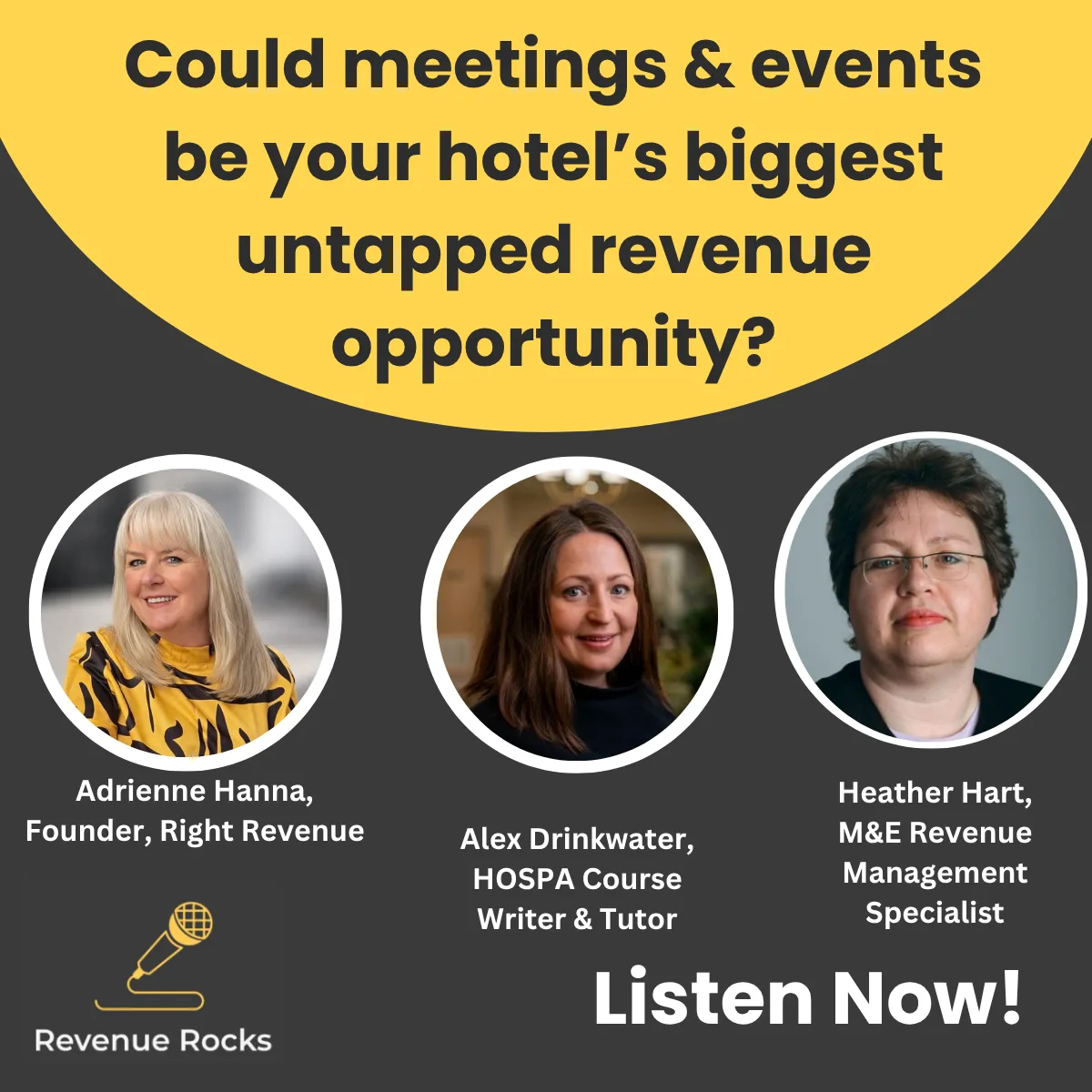
We recently explored this topic on the Revenue Rocks Podcast, sitting down with industry experts Heather Hart and Alex Drinkwater to unpack why meetings and events deserve a far bigger seat at the commercial table - and what hotels need to do to unlock their full potential.
Why Meetings & Events Have Been Overlooked
One of the clearest themes to emerge from the conversation was that meetings and events have too often lacked true ownership within hotel businesses. Depending on the property, responsibility may sit across sales, food and beverage, operations or revenue management — but rarely with one clear commercial champion.
As Heather Hart put it:
“In most hotel companies, there’s no one at senior level who owns and champions meetings and events.”
The result is that meetings and events can unintentionally become the “poor relation” of commercial conversations — discussed after bedrooms rather than alongside them, despite their potential to drive meaningful revenue growth.
A More Complex Revenue Puzzle
Unlike bedrooms, meetings and events are inherently more nuanced. A hotel room typically accommodates one or two guests. Function space, meanwhile, may host ten delegates one day and 400 guests the next.
Hotels must balance room configurations, delegate numbers, lead times, conversion rates, pricing strategy and profitability — all while trying to maximise space utilisation.
This complexity has often made meetings and events more difficult to optimise, particularly when compared with the mature systems and frameworks supporting rooms revenue management. However, complexity should not be mistaken for impossibility. The same commercial principles still apply — selling the right product, to the right customer, at the right time and at the right price — but in a far more layered environment.
Why Momentum Is Finally Building
Encouragingly, the industry is beginning to catch up.
Technology is improving, benchmarking tools are becoming more sophisticated and, perhaps most importantly, industry mindset is shifting. Meetings and events are increasingly being recognised as a meaningful commercial driver rather than simply a support function. This is in part due the efforts of Tom Finn of Edwards & Finn, who has hosted a series of commercial leadership forums focused on addressing the barriers that have historically held meetings and events back from achieving the commercial recognition and strategic focus it deserves.
“The change I’ve seen in the last two or three years is probably bigger than the change I’ve seen in the last 10 or 15 years put together, ” says Alex. That progress is also being supported by greater education and consistency around performance measurement, helping hotels better understand what success really looks like in this segment.
The Metrics That Matter
A growing framework of metrics is emerging to support stronger commercial decision-making in meetings and events, including:
Revenue per square metre (or foot)
Revenue per delegate
Revenue per event
Lead time
Delegate density
Conversion rate
These measures help hotels move beyond instinct and anecdotal reporting, offering a clearer understanding of how effectively space is performing and where commercial opportunities may exist.
But measurement alone is only part of the story. The real value comes when data begins to inform action - helping hotels understand not only what has happened, but what should happen next.
Looking Beyond Bedrooms
For hotels looking to take meetings and events more seriously, the first step does not need to be complicated.
It starts with understanding the true value of the space already available and recognising that function rooms are not simply there to support room sales.
“Unless you truly understand the value of your meeting space in its own right, you can’t really look at the whole jigsaw puzzle, ” Heather emphasised.
The hotels that will thrive in the years ahead are likely to be the ones that stop viewing meetings and events as secondary and start recognising them as a meaningful commercial driver in their own right.
Because the future of hotel revenue isn’t just about filling bedrooms.
It’s about maximising every square metre of opportunity.
To hear more from Alex and Heather about how to unlock additional M&E revenue, listen to the full podcast here
Latest from the blog

1 min read
What makes guests travel further and pay more for a hotel experience? In this episode of Revenue Rocks , Adrienne Hanna talks to Michael Beare from Finn Lough about creating demand, communicating value and turning…
4 min read
Learning revenue management in theory is one thing. Seeing how it actually works within a live hotel is where it really starts to come to life. That’s why we’re so pleased to be working with Edge Hotel School and…

6 min read
There’s been plenty of noise around England’s proposed tourist tax, but for hotels the bigger question is simple: what will it do to the final price the guest sees? With different areas potentially setting different…
Address
Right Revenue
5 Windmill Business Park
Saintfield
Ballynahinch
BT24 7DX